Japanese Knotweed in Inverclyde. What Every Homeowner Needs to Know

Updated: Apr 21
Japanese knotweed. Two words that can wipe thousands off your property value before you've even put the kettle on.
It sounds dramatic. It isn't. This plant, introduced to the UK by the Victorians who thought it looked "kind of nice" has been quietly causing chaos ever since. And here in Inverclyde, it's more of a problem than most people realise.
I work across the area as a local handyman and property maintenance contractor. I come across knotweed more often than you'd think, tucked behind fences, creeping along garden walls, taking over patches of ground that nobody's paid much attention to. Most of the time, the homeowner has no idea what it is. By the time they find out, it's become a big problem.
I've been seeing this stuff a lot lately. So I thought I'd put together a guide. Not to scare you unnecessarily, but to give you the facts you need. Because with knotweed, what you don't know can genuinely cost you.
It's Already Here
According to invasive plant specialists Environet, the local scale of the problem is considerable. Within a five-mile radius, the PA15 postcode area covering Greenock has 117 recorded sightings. Gourock (PA19) has 76, while the Wemyss Bay area has 40.
Nationally, Environet estimates that around 5% of UK homes are affected by Japanese knotweed. The figures for Inverclyde indicate that the local situation is at least as serious as the wider national picture.
River Clyde Homes has already issued warnings to local residents about it. Inverclyde Council has its own guidance page on dealing with it. This isn't a problem that's coming to the area; it arrived a while ago and has been making a pest of itself ever since.
Inverclyde's wet, damp, and soggy west coast climate, combined with our riverbanks and wastelands, creates an especially hospitable environment for this menace. If it hasn't already appeared on your property, there's a good chance it aint far away!
How to Identify It
The tricky thing about Japanese knotweed (Reynoutria japonica)
is that it looks completely different depending on the time of year. Here's what to look for through the seasons:
Spring: the asparagus imposter

In early spring, knotweed pushes up from the ground as reddish-purple shoots that look remarkably like asparagus spears. Don't be fooled. Although I believe they're edible at this stage, they grow fast, up to 10cm a day, and within weeks those innocent looking shoots become something altogether more serious.

Summer - the bamboo that isn't bamboo

By summer, the plant is in full growth, reaching 2 to 3 meters tall. The hollow stems are green with distinctive purple speckles, bamboo-like in appearance but not bamboo. Large shield-shaped or heart-shaped leaves grow in a zigzag pattern up the stems, bright green and smooth to the touch. In late summer, clusters of small creamy-white flowers appear. If you see this combination - hollow speckled stems, shovel-shaped leaves in a zigzag, creamy flowers - you've found it.
Close up of the creamy white flowers in clusters, late summer

Autumn - the slow retreat
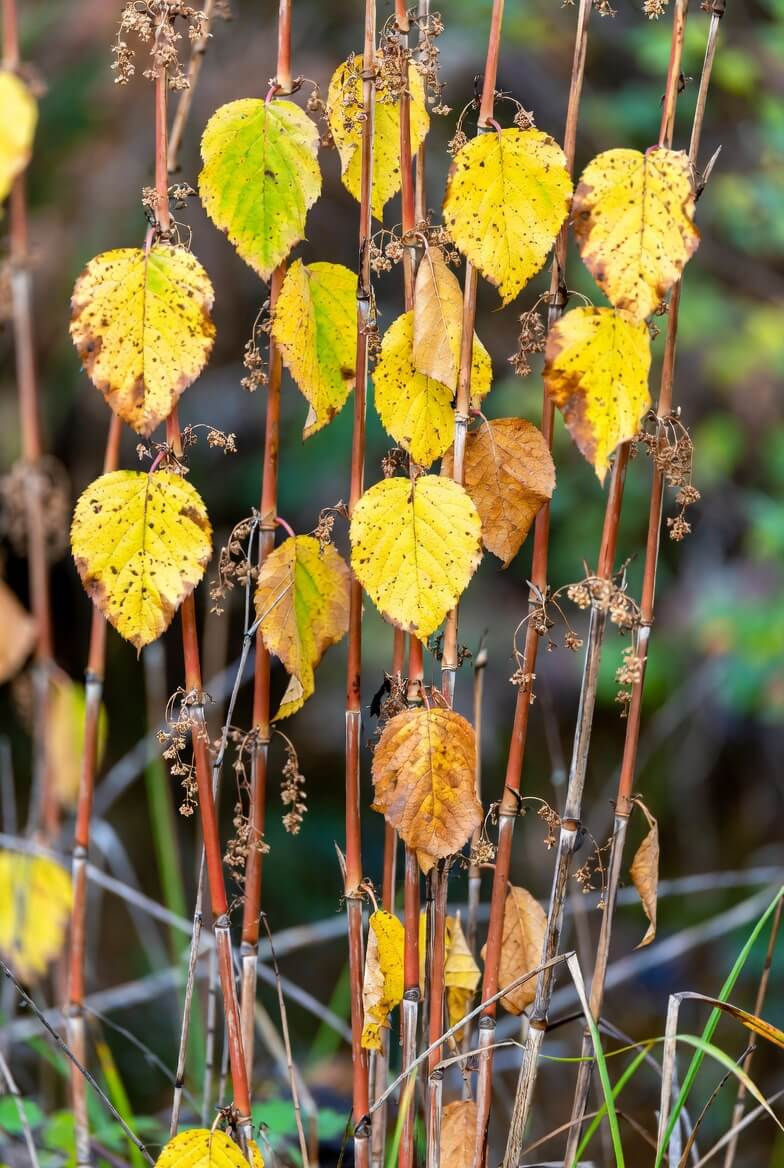
Winter - the skeleton

Above ground you'll see brown brittle hollow canes standing in the ground. Easy to miss, easy to mistake for something else. Underground, the root system is quietly waiting.
The roots - this is what causes the havoc

What you see above ground is the least of your worries. The roots, called rhizomes, can grow 3 metres deep and spread 7 metres out in every direction. Snap a rhizome and you'll see it's bright orange inside, a useful identifier. And here's the really alarming part: a fragment of root as small as your thumbnail can generate an entirely new plant. The plant can also stay dormant underground for up to 20 years.
What You Must Never Do
If you think you've found knotweed, resist the urge to deal with it yourself. Specifically:
Don't strim, mow or cut it - you'll create fragments that spread the plant further
Don't dig around it - disturbing the soil spreads rhizome fragments
Don't put any part of it in your garden waste bin, compost heap or a skip - this is illegal
These seem like obvious responses to a plant taking over your garden. They're also the most common mistakes people make and they turn a manageable problem into a much bigger one.
What the Law Says in Scotland
In Scotland, knotweed is covered by the Wildlife and Natural Environment (Scotland) Act 2011. In plain terms - it is illegal to cause it to spread into the wild. You are not legally required to remove it from your land, but you are legally required to stop it spreading.
If it spreads from your property onto a neighbour's land, you could face civil prosecution. If a neighbour's knotweed is encroaching onto yours, your first step is to write to them and request they deal with it. If that goes nowhere, legal advice may be required.
SEPA, the Scottish Environment Protection Agency, oversees waste disposal relating to knotweed. They're not responsible for removing it from your property. That's your job.
If You're Planning to Sell Your Home, This Is the Section You Really Need to Read
Mortgage lenders are nervous about knotweed and they have been for years. The plant can damage foundations, drains and walls, and lenders don't like uncertainty when it comes to the long-term value of a property they're lending against.
The Royal Institution of Chartered Surveyors (RICS) updated its guidance in 2022. Surveyors now assess knotweed risk based on proximity to the property:
More than 7 metres away on neighbouring land - low risk, mortgages generally proceed
Within 7 metres but outside your boundary - lenders will likely require a management plan
Within your boundary but more than 7 metres from the building - professional assessment required
Within your boundary and within 7 metres of the building - most serious category, lenders will require a full professional treatment plan with an insurance-backed guarantee
Even knotweed on a neighbour's property within 3 metres of your boundary can cause mortgage complications. And most buildings insurance policies won't cover knotweed damage and any repairs come entirely out of your own pocket.
Treatment costs vary, but even a small infestation can run to several thousand pounds. A serious one can exceed £30,000. Having a professional management plan and an insurance-backed guarantee in place can satisfy most lenders and allow sales to proceed, but that process takes time, and knotweed doesn't wait while you sort the paperwork.
The lesson here is simple. Find it early, deal with it properly.
Treatment - There's No Quick Fix
Physical excavation is an option but it's expensive and still risks leaving fragments behind. The most widely used treatment is herbicide, specifically glyphosate, applied by knapsack sprayer or injected directly into the stems.
It is not a one-off job. A typical treatment programme takes 3 to 5 years, with applications carried out in late summer when the plant is channelling energy into its root system. After successful treatment, the ground should still be monitored - rhizomes can lie dormant for years and regrow if the soil is disturbed.
Anyone applying herbicides professionally must hold pesticide application certificates and carry out a COSHH assessment. If the plant is near a watercourse, common in Inverclyde given our rivers and burns, additional permissions are required from SEPA.
Disposal - This Is Where It Stops Being a Gardening Problem and Becomes a Legal One
Knotweed waste, plant material and contaminated soil, is classified as controlled waste in Scotland. That means:
It must be transported by a SEPA licensed waste carrier
It can only be disposed of at a licensed landfill
Proper waste transfer documentation must accompany every load
All containers must be sealed and covered during transport
No skips. No garden waste bins. No compost. Fly-tipping knotweed waste is a serious offence.
If you need specialist help in the area, DS Japanese Knotweed Specialists are based right here in Greenock and cover Inverclyde and beyond, worth a call if you suspect you have a problem.
Think You’ve Found Japanese Knotweed?
If you’re not sure, don’t guess.
Why not send me a clear photo and a rough idea of where it’s growing (garden, boundary, near the house). I’ll take a quick look and tell you honestly whether it looks like knotweed or not. No charge. No obligation.
If it does look like knotweed, I’ll point you towards a reputable specialist. If it isn’t, you’ve saved yourself a lot of unnecessary worry.
Either way, you’ll know where you stand.
📩 Send a photo here: housetight@aol.com or WhatsApp: 07303 140185
What to Do If You Find It
Don't panic - it's manageable if caught and handled properly
Don't disturb it - no cutting, strimming or digging
Contact a specialist - look for a contractor accredited by the Property Care Association (PCA)
Get a management plan in place - especially if you're thinking about selling
Report it - you can log sightings with the Scottish Invasive Species Initiative at invasivespecies.scot
At Housetight I cover general property maintenance and handyman services across Inverclyde. Full refurbishments, small repairs, fencing, decking and a lot more. I'm not a knotweed removal specialist, that requires its own certification and setup, but if you spot something you're not sure about, I'm happy to take a look and point you in the right direction. Sometimes the most useful thing is just knowing what you're dealing with before you call anyone else. And if there's anything else you need sorted while you're at it, feel free to get in touch.
Comments